- Board-Certified • All Ages • Hopewell Junction, NY
Music Therapy, Classes
& Workshops for All Ages
From toddler music play classes to board-certified individual music therapy three distinct programs using the power of music to build communication, confidence, emotional regulation, and joy in children, teens, and adults. No musical experience required.

- Our Programs
Three Ways to Experience the Power of Music at
Sensory Stepping Stones
Whether you are looking for clinical music therapy to address a specific therapeutic goal, a structured music class for your toddler, or a small-group music pathway program for your school-age child or teen, Sensory Stepping Stones offers three distinct music programs each designed for a different age range, purpose, and level of need.

Clinical Therapy
Individual Music Therapy
Board-certified music therapy tailored to each client’s specific therapeutic goals addressing physical, emotional, cognitive, and social needs through a therapeutic relationship with music. For children through adults. No musical skills required.



Clinical Therapy
Music Classes for Younger Children
Fun, interactive group music sessions for children ages 1 to 5 using singing, instruments, and movement to build communication, socialization, and self-expression skills in a playful, welcoming group environment.



Skills Program
Music Classes for Older Children & Teens
Small-group music pathway classes for children kindergarten through 12th grade building musical skills, creativity, self-esteem, and emotional communication over six-week sessions. All supplies included.

- The Profession
Music Therapy Is an
Established Health
Profession Not Just a Nice Activity
Music Therapy Addresses These Goal Areas
- Promote Wellness
- Manage Stress
- Alleviate Pain
- Express Feelings
- Enhance Memory
- Reduce Anxiety
- Improve Communication
- Support Physical Rehabilitation
- Increase Academic Retention
- Strengthen Self-Expression
- Improve Attention & Focus
- Build Socialization Skills
Research in music therapy supports its effectiveness in overall physical rehabilitation, facilitating movement, increasing motivation to engage in treatment, providing emotional support, and providing an outlet for expression of feelings. (American Music Therapy Association)
Music therapy is a recognized health profession in which music is used within a therapeutic relationship to address physical, emotional, cognitive, and social needs of individuals across all ages. It is not music education, entertainment, or passive listening it is a clinical discipline practiced by board-certified professionals trained in both music and therapeutic technique.
After assessing the strengths and needs of each client, a qualified music therapist provides indicated treatment including creating, singing, moving to, and listening to music within a structured session designed around the client’s individualized goals. Through musical involvement in the therapeutic context, clients’ abilities are strengthened and transferred to other areas of their lives.
Music therapy also provides avenues for communication that can be particularly powerful for those who find it difficult to express themselves in words including young children, individuals with autism spectrum disorder, and clients managing mental health challenges that limit verbal communication.
16+
Years of board-certified music therapy experience at the clinic
4
Distinct program offerings from toddler through adult
0
Musical skills required to benefit from any program
- Why Music Works
The Physiological and Neurological Effects of Music
The therapeutic power of music is not a matter of opinion it is measurable biology. Music affects the brain and body through multiple documented mechanisms, which is precisely why it is effective as a clinical intervention across such a wide range of populations and conditions.

Reduced Heart Rate
Listening to appropriately selected music measurably reduces heart rate signaling to the nervous system that it is safe to relax, regulate, and engage.


Lowered Blood Pressure
Music-based interventions consistently reduce blood pressure creating physiological calm that supports emotional regulation, pain management, and therapeutic engagement.

Reduced Cortisol
Music lowers cortisol the primary stress hormone reducing physiological anxiety and creating the neurological conditions needed for learning, connection, and emotional processing.

Reduced Anxiety
Music therapy reduces both subjective and physiological anxiety making it particularly effective for clients who are resistant to or anxious in traditional clinical settings.

Improved Mood
Active music-making releases dopamine the brain's reward chemical improving mood, motivation, and the overall emotional state that makes therapeutic and educational engagement possible.

Enhanced Neural Connectivity
Musical engagement activates more simultaneous brain regions than almost any other human activity building neural connectivity that transfers to language, memory, attention, and motor function.

- Clinical Service
Individual Music Therapy
For All Ages and All Abilities
Individual music therapy at Sensory Stepping Stones is delivered by Ashley E. Barton, MT-BC a board-certified music therapist with over 16 years of clinical experience working with children with special needs in schools, clinics, and private practice settings throughout the Hudson Valley.
Sessions are tailored to each client’s unique therapeutic goals which may include improving communication, building social skills, managing anxiety, developing emotional expression, supporting physical rehabilitation, or addressing specific IEP and 504 plan goals. The music therapist may incorporate singing, instrument play, songwriting, music listening, lyric analysis, or movement to music depending on what will be most therapeutically productive for that specific client in that specific session.
The participant does not need any musical ability. People of all ages and all levels of functioning benefit from music therapy because the therapeutic mechanism is the relationship between the client and the music, not the performance of it.
IEP and 504 Integration: Ashley frequently incorporates clients’ active IEP and 504 plan goals into music therapy sessions making music therapy a meaningful clinical complement to a child’s school-based support services.
Populations Music Therapy Serves
- Autism Spectrum Disorder
- Addiction Treatment
- Child & Adolescent Behavior
- Mental Health
- Acquired Brain Injury
- Dementia & Hospice Care
- Pain Management
- Neonatal Intensive Care
- Sensory Processing Disorder
- ADHD
- Special Education
- For Toddlers & Young Children
Music Classes for Children Ages 1 to 5
Our music classes for younger children are joyful, active group sessions designed to use music as a pathway to learning, connection, and self-expression at the age when the brain is most receptive to musical and social development. Held on Mondays and open for registration through our online scheduling link.
- Ages 3 to 5
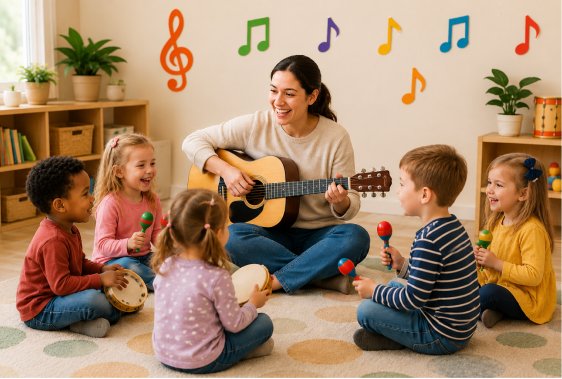
Music Play Group Ages 3–5
An engaging group music session that gives children the opportunity to sing, play instruments, and move together while exploring different topics and themes each week. Sessions use voice, instruments, and movement to build communication, socialization, and self-expression skills making learning feel like pure play.
- Mondays at 1:30 PM
- Children ages 3 to 5 years old
- Ages 1 to 2
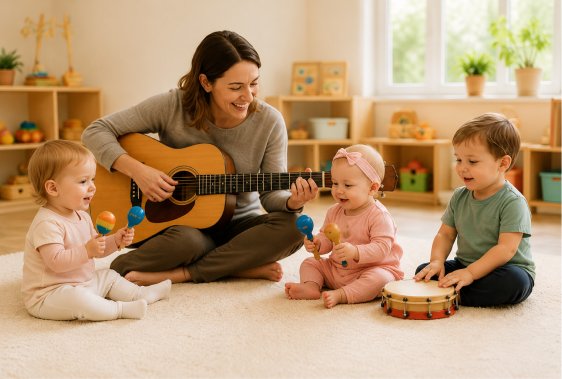
Tiny Tunes Ages 1–2
A gentle, joyful music group for the youngest learners introducing toddlers to the world of music through songs, simple instruments, and movement in a warm, stimulating group setting. This class supports early language development, social bonding, and sensory exploration through the universal language of music.
- Mondays at 2:30 PM
- Children ages 1 and 2 years old
Registration for both young children’s music classes is available through our online scheduling link. No prior musical experience is needed for the child or the parent attending with them.
- For School-Age Children & Teens
Music Classes A Pathway for Strength
Our music pathway classes for older children and teens are small-group programs that go beyond music education using musical skill-building as a vehicle for developing creativity, self-esteem, emotional communication, and confidence. Each class runs for six weeks with all supplies included.
- Kindergarten through 5th Grade
Music Class Level I
A foundational music class for elementary-age students exploring individual musical skills through instruments and voice to build creativity, communication, and self-esteem. Sessions are small to ensure every participant receives individual attention and genuine musical development.
- 6-week program
- All musical supplies included
- 6th Grade through 12th Grade
Music Class Level II
A music pathway class designed for middle & high school students building on foundational musical skills deepening emotional expression, communication, creative development through instruments, group musical exploration. Small group sizes ensure meaningful participation for every student.
- 6-week program
- All musical supplies included
Registration for Music Classes Level I and II requires a parent consultation with Ashley Barton first. Please call (914) 244-4101 to schedule your consultation appointment before registering for these classes.
- Outcomes & Results
What Children and Families Gain
Through Music Therapy & Classes
Whether through individual clinical music therapy or group music classes, the outcomes families most consistently describe go beyond musical skill they are changes in how their child communicates, connects, manages emotions, and sees themselves.

Improved Communication Skills
Music provides an alternative channel for expression particularly valuable for children with limited verbal communication, autism, or language delays who can express through music what they cannot yet say in words.
Stronger Emotional Regulation
Music therapy provides structured tools for identifying and managing emotions reducing the frequency and intensity of anxiety, emotional outbursts, and stress responses in daily life.
Better Social Skills & Peer Connection
Music provides an alternative channel for expression particularly valuable for children with limited verbal communication, autism, or language delays who can express through music what they cannot yet say in words.
Enhanced Self-Esteem & Confidence
Successfully creating music regardless of prior ability builds authentic self-confidence. Children who experience themselves as capable and creative in a music setting carry that experience into other areas of life.
Increased Attention and Focus
Musical activities naturally require sustained attention and focused engagement building the same neural pathways that support academic concentration, task completion, and classroom participation.
Reduced Stress & Physiological Calm
Music measurably lowers heart rate, blood pressure, and cortisol creating a calmer baseline state that supports learning, social engagement, and the emotional availability needed for therapeutic progress.
- Parent stories
Real Families. Real Results.
You’re not the first family to walk in feeling hopeless. And you won’t be the last to walk out feeling seen.
We spent years trying different programs, but this was the first place where our son truly felt understood. The changes in his confidence, focus, and communication have been incredible for our whole family.
Emma & Daniel
Parents of Liam, age 7
Our daughter used to dread reading and schoolwork. Now she proudly reads bedtime stories to her little brother. The patience, warmth, and support here made all the difference.
Sophia & Michael
Parents of Ava, age 9
We spent years trying different programs, but this was the first place where our son truly felt understood. The changes in his confidence, focus, and communication have been incredible for our whole family.
Emma & Daniel
Parents of Liam, age 7
- Questions parents ask us
Honest answers to the things you're actually wondering.
Music therapy is a clinical health service delivered by a board-certified music therapist (MT-BC) with specific therapeutic goals, clinical documentation, and a treatment plan tailored to each client's assessed needs. Music classes are structured educational group programs designed to develop musical skills, creativity, and social-emotional growth in a group setting. Both use music purposefully, but music therapy is a credentialed clinical intervention while music classes are enrichment and developmental programs. Both are available at Sensory Stepping Stones.
Still have questions? We’d rather you ask than wonder.
- Take the first step
You don't need to have it figured out. You just need to start.
A free 30-minute conversation, no clipboards or scripts. Just us, you, and whatever you’re carrying.