- Cognitive & Memory Training
Cognitive & Memory Training Building a Sharper, More Capable Brain at Any Age
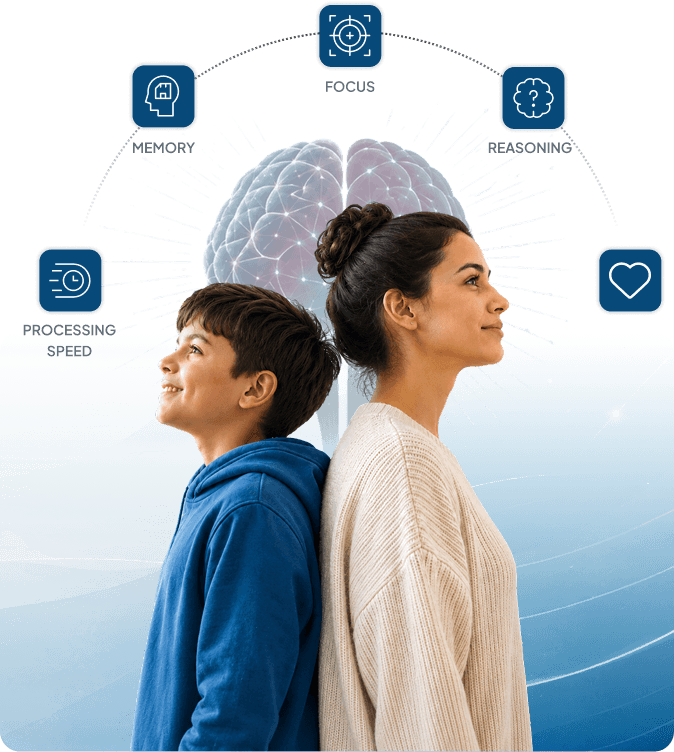
A progressive, evidence-based brain fitness program with over 50 levels of targeted exercises designed to strengthen working memory, processing speed, attention, reasoning, and emotional regulation in children and adults.
- What Is It?
Brain Fitness Training That Targets the Root of
Memory and Attention Challenges
Cognitive and Memory Training is a structured, progressive brain fitness program designed to directly strengthen the cognitive skills that underpin learning, attention, and daily functioning. Rather than teaching a child to compensate for a weak memory or short attention span, this program trains the brain itself to perform those functions more effectively.
The program works by presenting the nervous system with carefully calibrated cognitive challenges exercises targeting memory, processing speed, visual perception, reasoning, and impulse control and progressively increasing difficulty as the brain adapts. Over 30 to 40 sessions, the neural pathways responsible for these functions become stronger, more efficient, and more reliable.
The result is a child who can sit with a task longer, retain multi-step instructions, manage frustration more effectively, and engage academically in a way that reflects their true potential not just their processing limitations.
50+
Multi-level training programs across all cognitive skill areas
30–40
Total individual sessions in a full program
2×
Minimum sessions per week for optimal results
No diagnosis required. No diagnosis required. Cognitive and Memory Training is effective for children with formal diagnoses and for children who are bright but consistently underperforming relative to their ability without any clinical label.
What Makes Interactive Metronome® Unique
- Trains the brain directly not just coping strategies or workarounds
- Over 50 progressive levels adapting to your child's growth in real time
- Targets 19 distinct cognitive and motor skill areas simultaneously
- Measurable improvement visible session by session
- Works for children with and without a formal diagnosis
- Frequently combined with other programs for deeper impact
- Is This the Right Fit?
Signs Your Child May Have a Memory or Cognitive Processing Challenge
Children whose nervous systems struggle to self-regulate often present as distracted, impulsive, emotionally volatile, or socially withdrawn not because they lack effort or intelligence, but because their brain has not yet developed the regulatory capacity to function consistently in demanding environments. If you recognize several of the following patterns, neurofeedback may be exactly what is missing.
Forgets instructions moments after receiving them unable to retain and follow even two- or three-step directions at home or school without repeated.

Short attention span cannot stay focused on a task for more than a few minutes without becoming distracted or disengaged.

Schoolwork does not reflect their intelligence they clearly understand concepts verbally but cannot demonstrate it in written work.

Emotional outbursts when asked to complete difficult tasks frustration escalates quickly and disproportionately to the challenge.

Processing speed is noticeably slower than peers takes significantly longer to complete assignments, tests, or everyday tasks.

Skips steps in multi-part tasks loses track partway through chores, homework, or classroom projects and leaves them incomplete.

Difficulty identifying and naming emotions gets overwhelmed by feelings and struggles to regulate them in social or academic settings.

Poor motor coordination affecting writing, drawing, or physical tasks fine and gross motor skills lag behind cognitive development.

Cognitive and Memory Training is also used as a performance enhancement tool for children without diagnosed challenges who want to sharpen academic stamina, improve test-taking focus, or develop stronger executive functioning skills heading into a new school year.
- Inside the Program
19 Cognitive Skill Areas
Addressed Through Training
The Cognitive and Memory Training program at Sensory Stepping Stones targets a comprehensive range of cognitive and motor skill areas through over 50 progressive training levels. Each client’s program is shaped by their evaluation results to prioritize the areas where improvement will have the greatest daily impact.
Visual Motor Skills
Coordination between what the eyes see and what the hands do essential for writing, drawing, and fine motor tasks.
Visual Perception, Scanning & Tracking
The brain's ability to accurately interpret, search, and follow visual information directly impacting reading fluency and classroom learning.
Attention & Focus Skills
The brain's ability to accurately interpret, search, and follow visual information directly impacting reading fluency and classroom learning.
Working & Short-Term Memory
Holding and manipulating information in the mind long enough to use it essential for following directions, completing tasks, and learning new material.
Listening Skills
Active auditory attention the ability to receive, filter, and retain spoken information in real time without losing the thread.
Visuospatial Classification & Sequencing
Understanding spatial relationships and organizing information in the correct order foundational for math, science, and logical reasoning.
Conceptual Skills
Understanding abstract ideas, making connections between concepts, and applying knowledge flexibly across different contexts.
Logical Skills
Reasoning through problems systematically, identifying patterns, and drawing accurate conclusions from available information.
Impulsivity Control
Managing the urge to act before thinking reducing impulsive behaviors in class, during activities, and in social interactions.
Fine Motor Skills
Small muscle control for handwriting, cutting, buttoning, and other daily tasks that require precision and dexterity.
Mental Processing Speed
How quickly the brain receives, processes, and responds to information affecting academic performance, conversation, and task completion.
Alternating, Selective & Divided Attention
Shifting focus between tasks, selecting relevant information from distractions, and managing multiple streams of input at once.
Auditory & Visual Processing Speed
How quickly and accurately the brain processes spoken and written input affecting listening comprehension, reading, and classroom participation.
Detailed Reading
Sustaining focus through longer passages, retaining what was read, and accurately interpreting written information across academic subjects.
Response Inhibition
The ability to pause before acting stopping impulsive responses and choosing deliberate, appropriate behaviors instead.
Sequencing
Organizing steps in the correct order critical for completing tasks, following routines, and producing structured written work.
Auditory & Visual Attention
Focused concentration on auditory and visual stimuli sustaining engagement with lessons, conversations, and instructional materials.
Emotional Regulation Skills
Recognizing, understanding, and managing emotional responses reducing frustration-driven meltdowns and building resilience under pressure.
- Outcomes & Results
What Families Experience After
Completing the Program
Families who complete the full Cognitive and Memory Training program consistently describe changes that go beyond the clinic improvements that reshape how their child experiences school, home life, friendships, and their own sense of capability.
Stronger Working Memory
Children hold onto multi-step instructions long enough to complete them independently without constant reminders or adult re-direction.
Faster Thinking & Processing Speed
The lag between receiving information and responding narrows making classroom participation, conversation, and test-taking noticeably less effortful.
Improved Hand-Eye Coordination
Faster and more accurate coordination between visual input and physical response improving handwriting, sports, and fine motor tasks.
Better Emotional Self-Regulation
Children recognize their emotional state earlier and respond more appropriately reducing the frequency and intensity of frustration-driven outbursts.
Greater Academic Confidence
As the brain becomes more capable of handling the cognitive demands of school, children begin producing work that actually reflects their intelligence and they feel it.
Stronger Reasoning & Problem-Solving
The ability to think through challenges systematically rather than reacting impulsively or shutting down improves both academically and socially.
- Parent stories
Real Families. Real Results.
You’re not the first family to walk in feeling hopeless. And you won’t be the last to walk out feeling seen.
We spent years trying different programs, but this was the first place where our son truly felt understood. The changes in his confidence, focus, and communication have been incredible for our whole family.
Emma & Daniel
Parents of Liam, age 7
Our daughter used to dread reading and schoolwork. Now she proudly reads bedtime stories to her little brother. The patience, warmth, and support here made all the difference.
Sophia & Michael
Parents of Ava, age 9
We spent years trying different programs, but this was the first place where our son truly felt understood. The changes in his confidence, focus, and communication have been incredible for our whole family.
Emma & Daniel
Parents of Liam, age 7
- Questions parents ask us
Honest answers to the things you're actually wondering.
Interactive Metronome® is a computer-based brain training program that uses rhythmic motor tasks and real-time millisecond feedback to improve the brain's internal timing system. The participant performs hand and foot movements in sync with a computer-generated beat. Sensors measure timing accuracy to the millisecond and provide instant feedback — training the brain to self-correct and regulate its own timing more effectively over 15 to 21 sessions.
No. Interactive Metronome® is effective for children with diagnosed conditions like ADHD, autism, sensory processing disorder, and dyslexia — as well as for children without any diagnosis who simply need support with attention, coordination, or sequencing. It is also used as a performance enhancement tool for student athletes and adults.
The full Interactive Metronome® program consists of 15 to 21 individual sessions, each lasting 45 to 60 minutes. Sessions are scheduled at least twice per week for the best outcomes. Sessions are available seven days a week at our Hopewell Junction clinic.
Yes, and it frequently is. Interactive Metronome® is most commonly offered as part of a larger program package that includes Neuro Integration Therapy™, Cognitive and Memory Training, and Neuro/Bio Educational Feedback. Our clinical team coordinates all programs to work together seamlessly for the most comprehensive outcomes.
Many families and clients begin noticing changes within the first several sessions — particularly improved ability to follow instructions, better focus during tasks, and increased body awareness. More significant changes in academic performance, coordination, and social engagement typically become evident as the program progresses. Because IM provides objective data, improvement is measurable — not just anecdotal.
Many families begin to notice changes during the 12-day clinic phase — including improvements in sleep, reduced sensory reactivity, and calmer behavior. More significant changes in focus, social connection, and emotional regulation typically emerge over the full 30 days and continue to develop in the weeks following program completion. Individual results depend on the person's starting point and the specific areas being addressed.
Sensory Stepping Stones is an out-of-network provider. Families pay at the time of service and we provide completed 1500 reimbursement forms with treatment and diagnosis codes for submission to your insurance company. Many families receive partial reimbursement through out-of-network behavioral health benefits. We recommend calling your insurer before your first appointment to ask about your specific out-of-network coverage.
Absolutely. Adults with traumatic brain injury, concussion, Parkinson's Disease, multiple sclerosis, or age-related cognitive slowdown benefit significantly from Interactive Metronome® training. Adults seeking to improve athletic performance, reaction time, or mental sharpness also use the program. The same protocol applies — sessions are 45 to 60 minutes, at least twice per week, for 15 to 21 sessions total.
Still have questions? We’d rather you ask than wonder.
- Take the first step
You don't need to have it figured out. You just need to start.
A free 30-minute conversation, no clipboards or scripts. Just us, you, and whatever you’re carrying.