
- Evidence-Based • Drug-Free • Hopewell Junction, NY
Interactive Metronome® Improving Timing, Focus & Coordination From the Inside Out
A research-backed training program that rewires the brain’s internal timing helping children and adults with ADHD, sensory processing challenges, coordination difficulties, and attention deficits finally keep up with the world around them.
- What Is It?
The Science of Timing and Why It Changes Everything
Interactive Metronome® (IM) is an evidence-based, research-backed training program that targets the brain’s internal clock the neurological timing system that governs how well a person can pay attention, plan movements, process sequences, and coordinate actions in real time.
When this timing system is off, even a bright, capable child can struggle to follow multi-step directions, participate in organized sports, complete homework independently, or keep pace with peers socially and academically. The gap between what they are capable of and what they can actually do becomes a daily source of frustration for the child and for the family.
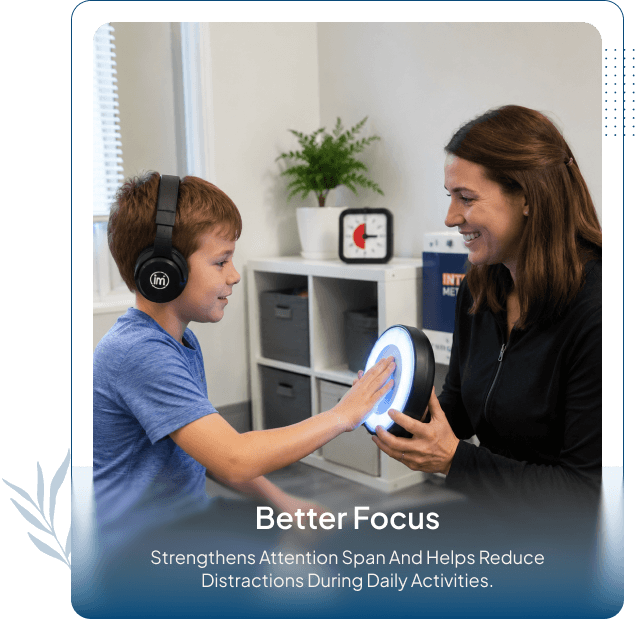
Interactive Metronome® works by training the brain to synchronize its own timing through a series of precisely measured motor tasks. The program provides real-time auditory and visual feedback as the person performs rhythmic movements to a computer-generated beat and the brain gradually learns to self-correct and regulate its own timing more efficiently.
15–21
Total sessions in a full IM program
2×
Minimum sessions per week for best results
7
Days a week sessions are available at the clinic
What Makes Interactive Metronome® Unique
- Targets neurological timing the root of many attention and coordination challenges
- Delivers real-time millisecond-level feedback to the brain
- Measurable progress is visible session by session
- Works for children with and without a formal diagnosis
- Effective for cognitive performance AND athletic performance
- Frequently combined with other programs for greater impact
No diagnosis required. Interactive Metronome® is effective for children with diagnosed conditions and for children and adults who simply want to sharpen their cognitive and physical performance without medication.
- Is This the Right Fit?
Signs Your Child May Have a Timing or Coordination Challenge
Many children with neurological timing difficulties are creative, intelligent, and eager to participate but their brain’s internal clock makes it difficult to keep up. If you recognize several of the following patterns in your child,Interactive Metronome® therapy may offer meaningful help.

Difficulty following multi-step directions forgets steps partway through even familiar tasks

Physical clumsiness or poor coordination bumps into things, struggles with sports or organized activities

Homework takes far longer than it should not due to lack of knowledge but difficulty staying organized and on-task

Social frustration desperately wants to fit in with peers but timing and coordination difficulties create barriers
Short attention span easily distracted mid-task and struggles to finish what was started

Struggles to participate in group activities or team sports falls behind peers and withdraws or acts out

Takes longer than peers to complete tasks processing speed is noticeably slower in classroom and social settings

Background noise filters poorly gets overwhelmed in busy classrooms or crowded environments and cannot focus

Interactive Metronome can also be used with children without a specific diagnosis to enhance cognitive performance, athletic coordination, and academic stamina. Many families use it as a performance tool, not just a remediation program.
- Inside the Program
How Interactive Metronome® Retrains the Brain's Timing System
The Interactive Metronome® program is built on a simple but powerful premise: the brain can be trained to improve its own internal timing through repetitive, feedback-driven practice. Here is how each of the three core components works together.
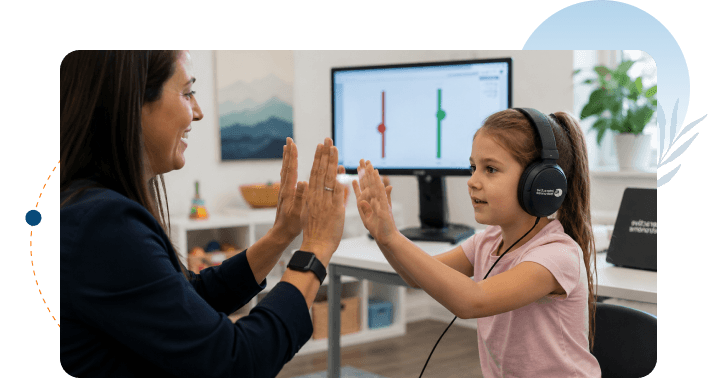
All three systems work together simultaneously during each session. This simultaneous stimulation is what sets Neuro Integration Therapy™ apart from conventional single-sense approaches, and why so many families see lasting improvements where other therapies have not delivered.
Rhythmic Motor Tasks
The participant performs a series of precise hand and foot movements clapping, tapping, or stepping in synchrony with a computer-generated rhythmic beat. The tasks begin simply and progressively increase in complexity as the client's timing improves. This trains both gross and fine motor coordination alongside cognitive processing.
Real-Time Millisecond Feedback
Unlike traditional therapy, IM provides immediate, objective feedback to the brain in milliseconds far faster than any therapist could. A sensor detects each movement and the system provides an auditory and visual signal indicating whether the response was early, late, or precisely on time. The brain uses this feedback to self-correct in the moment.
Rhythmic Motor Tasks
The program automatically adjusts challenge level based on real-time performance data keeping the brain working at the precise threshold where growth occurs. Tasks become more complex as timing improves, maintaining engagement and ensuring the brain continues to adapt throughout the full 15–21 sessions.
- Program Goals
What the Interactive Metronome®
Program Is Designed to Achieve
Each IM program is personalized around a client’s evaluation results and specific areas of difficulty. The overarching treatment goals addressed across all programs include the following:
Stronger peer participation and social confidence
Better ability to
follow multi-step directions
Enhanced body awareness and proprioception
Improved gross and fine motor coordination
Better academic stamina and task completion
Stronger ability to filter background noise
Expanded visual
field awareness
Faster mental processing speed
Greater confidence
in physical activities
Stronger peer participation and social confidence
Conditions IM Most Commonly Addresses
ADHD & Inattention
ADHD & Inattention
Dyslexia
Sensory Processing Disorder
Auditory Processing Disorder
Traumatic Brain Injury
Motor Coordination Delays
Parkinson's Disease
Developmental Delays
Concussion Recovery
Athletic Performance
Executive Functioning Deficits
IM as a Performance Tool
Interactive Metronome® is not just for children with diagnosed challenges. Student athletes, competitive performers, and adults looking to sharpen their reaction time, coordination, and mental processing also benefit significantly. The program is frequently used to enhance sports performance particularly in activities that require timing, rhythm, and spatial awareness such as basketball, gymnastics, swimming, and tennis.
- Outcomes & Results
What Families Experience
After Completing the IM Program
Families who complete the full Interactive Metronome® program consistently report improvements that extend far beyond the clinic changes that are visible at home, in school, on the field, and in social settings.

Homework Gets Done Independently
Children begin completing assignments without constant reminders, redirection, or adult supervision because the brain can now maintain the sequential focus required to finish what it starts.

Social Participation Increases
With improved timing and body awareness, children find it easier to participate in group conversations, pick up on social cues, and engage in cooperative play reducing the isolation that so many families describe.

Processing Speed Increases
The brain's ability to receive, interpret, and respond to information becomes noticeably faster reducing the cognitive lag that makes children seem inattentive or slow when they are neither.

Athletic Confidence Grows
Children who previously sat on the sidelines begin participating in sports, games, and group activities and coaches and teammates notice the improvement in coordination, reaction time, and teamwork.

Classroom Performance Improves
Teachers begin noticing that the child can follow classroom instructions more reliably, sustain attention during lessons, and produce work that more accurately reflects their actual ability.

Self-Esteem Rebuilds Naturally
As a child begins experiencing success in activities that once felt impossible, their belief in their own capability grows creating a positive cycle that extends well beyond the program itself.
- Parent stories
Real Families. Real Results.
You’re not the first family to walk in feeling hopeless. And you won’t be the last to walk out feeling seen.
We spent years trying different programs, but this was the first place where our son truly felt understood. The changes in his confidence, focus, and communication have been incredible for our whole family.
Emma & Daniel
Parents of Liam, age 7
Our daughter used to dread reading and schoolwork. Now she proudly reads bedtime stories to her little brother. The patience, warmth, and support here made all the difference.
Sophia & Michael
Parents of Ava, age 9
We spent years trying different programs, but this was the first place where our son truly felt understood. The changes in his confidence, focus, and communication have been incredible for our whole family.
Emma & Daniel
Parents of Liam, age 7
- Questions parents ask us
Honest answers to the things you're actually wondering.
Interactive Metronome® is a computer-based brain training program that uses rhythmic motor tasks and real-time millisecond feedback to improve the brain's internal timing system. The participant performs hand and foot movements in sync with a computer-generated beat. Sensors measure timing accuracy to the millisecond and provide instant feedback — training the brain to self-correct and regulate its own timing more effectively over 15 to 21 sessions.
No. Interactive Metronome® is effective for children with diagnosed conditions like ADHD, autism, sensory processing disorder, and dyslexia — as well as for children without any diagnosis who simply need support with attention, coordination, or sequencing. It is also used as a performance enhancement tool for student athletes and adults.
The full Interactive Metronome® program consists of 15 to 21 individual sessions, each lasting 45 to 60 minutes. Sessions are scheduled at least twice per week for the best outcomes. Sessions are available seven days a week at our Hopewell Junction clinic.
Yes, and it frequently is. Interactive Metronome® is most commonly offered as part of a larger program package that includes Neuro Integration Therapy™, Cognitive and Memory Training, and Neuro/Bio Educational Feedback. Our clinical team coordinates all programs to work together seamlessly for the most comprehensive outcomes.
Many families and clients begin noticing changes within the first several sessions — particularly improved ability to follow instructions, better focus during tasks, and increased body awareness. More significant changes in academic performance, coordination, and social engagement typically become evident as the program progresses. Because IM provides objective data, improvement is measurable — not just anecdotal.
Many families begin to notice changes during the 12-day clinic phase — including improvements in sleep, reduced sensory reactivity, and calmer behavior. More significant changes in focus, social connection, and emotional regulation typically emerge over the full 30 days and continue to develop in the weeks following program completion. Individual results depend on the person's starting point and the specific areas being addressed.
Sensory Stepping Stones is an out-of-network provider. Families pay at the time of service and we provide completed 1500 reimbursement forms with treatment and diagnosis codes for submission to your insurance company. Many families receive partial reimbursement through out-of-network behavioral health benefits. We recommend calling your insurer before your first appointment to ask about your specific out-of-network coverage.
Absolutely. Adults with traumatic brain injury, concussion, Parkinson's Disease, multiple sclerosis, or age-related cognitive slowdown benefit significantly from Interactive Metronome® training. Adults seeking to improve athletic performance, reaction time, or mental sharpness also use the program. The same protocol applies — sessions are 45 to 60 minutes, at least twice per week, for 15 to 21 sessions total.
Still have questions? We’d rather you ask than wonder.
- Take the first step
You don't need to have it figured out. You just need to start.
A free 30-minute conversation, no clipboards or scripts. Just us, you, and whatever you’re carrying.